White Clover
Home / Weed identification / White Clover
Pennsylvania weed ID · Lawn broadleaf
White Clover
Trifolium repens · Fabaceae (pea family)
- Perennial
- Broadleaf
- Non-native
If your lawn has patches of three-leaf clover with round white flowers buzzing with bees every June, you've got white clover, and whether that's a problem is partly up to you.
How to get rid of itAll weeds A–Z
What is white clover?
White clover is a low, creeping perennial legume that’s been planted in pastures and lawn seed mixes for generations. White clover identification is easy, but deciding what to do about it depends on how you feel about it. Some homeowners welcome it; others want a pure grass lawn.
It forms a partnership with soil bacteria that pull nitrogen from the air, so it stays green in lawns that are short on fertilizer. That’s why it’s often a sign of a lawn that’s hungry.
It doesn’t hurt anything, it feeds pollinators and it tolerates foot traffic. Still, it can crowd out grass and leave patches that look uneven, and the flowers bring bees to bare feet.
White clover identification: what to look for
Look for these features:
- Leaves: three oval leaflets, a quarter to three-quarters of an inch across, on long stalks. The edges are finely toothed and many leaflets have a pale, V-shaped watermark. Four-leaf clovers are rare mutations.
- Stems: smooth to slightly hairy, creeping along the ground and rooting at each joint, forming spreading patches.
- Flowers: round, white to pale pink heads, about half an inch to three-quarters of an inch across, made of 20 to 40 small pea-like flowers. They sit on their own stalks above the leaves from spring into fall, peaking in late spring and early summer.
- Seeds: tiny and hard-coated in small pods, able to sit dormant in the soil for years.


Where it grows in Pennsylvania
White clover grows in lawns, parks, roadsides, pastures and athletic fields across the state. It prefers full sun but will grow in part shade, and it does well in lawns that are thin, compacted or low in nitrogen.
In central PA it’s especially common in older lawns that haven’t been fertilized in years, in heavy clay that compacts easily and along mowed roadsides. Lawns that get regular fall fertilizer tend to have much less.
It also moves into new lawns quickly. Hard-coated seed can wait in the soil for years, so after grading, excavation or a utility trench, clover often sprouts in the fresh soil alongside the new grass. Low-nitrogen topsoil and subsoil make the problem worse.
White clover look-alikes
A few small lawn weeds also have three leaflets:
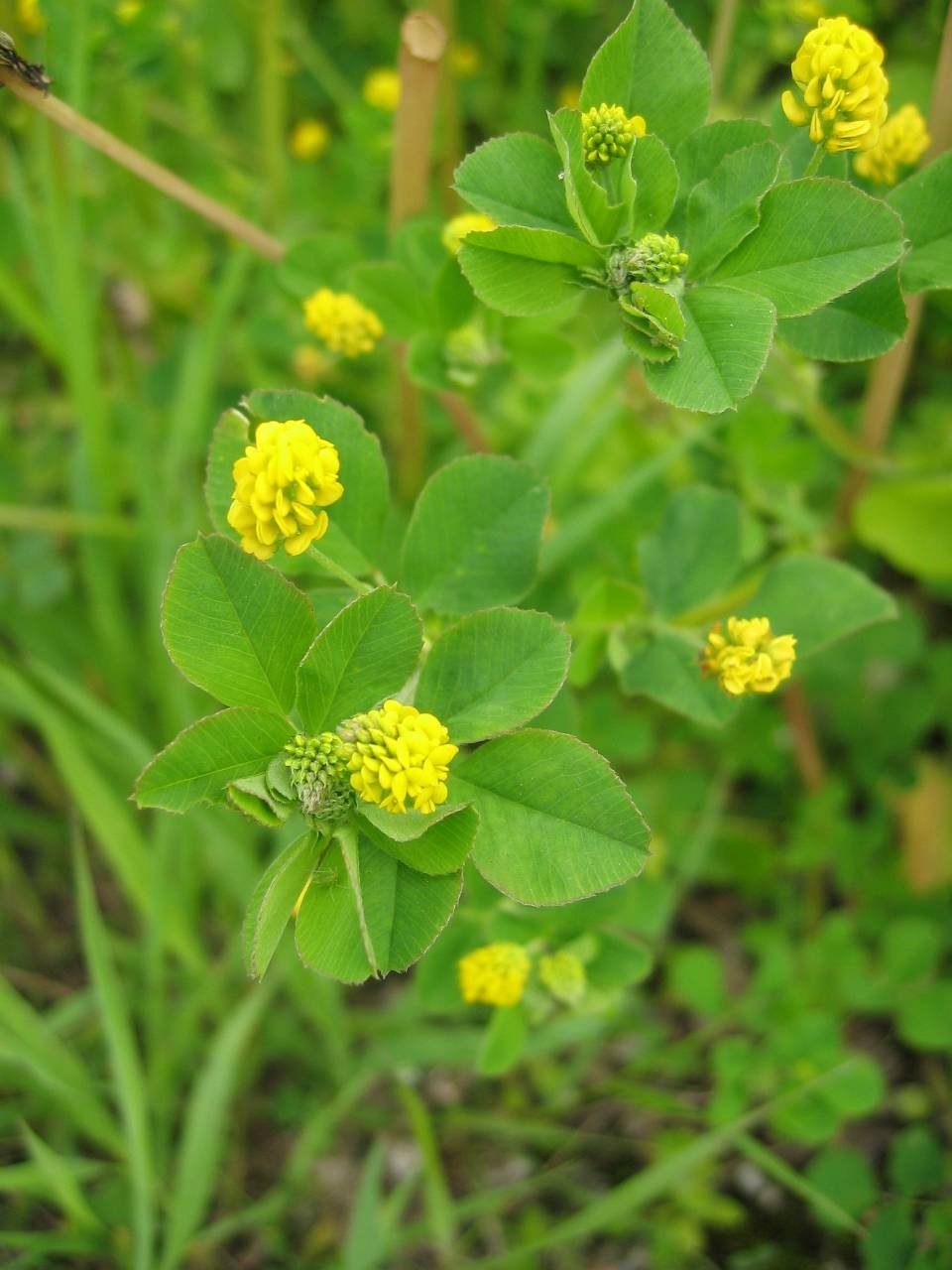
- Black medic has small, bright yellow flower heads. Its middle leaflet sits on a short stalk of its own.
- Yellow wood sorrel has heart-shaped leaflets that fold up at night and small yellow flowers with five petals.
- Large hop clover has small yellow flower heads that turn brown and papery as they age, like tiny hops.
- Red clover is taller and more upright, with larger, hairy leaves and pink-purple flower heads.
If the flowers are white and round and the plant creeps low, it’s white clover.
How to get rid of white clover
Hand and mechanical. Small patches can be pulled or dug, but the rooting stems break easily and regrow. Work slowly, loosen the soil and follow the stems to their ends. In beds, pull it out and mulch over the spot. A sharp hand weeder or a flat garden spade works better than fingers on the rooted runners.
Cultural. This is the most important step. White clover thrives in lawns low on nitrogen. Penn State Extension notes that adequate nitrogen fertility discourages clover patches. Fertilize mainly in fall, based on a soil test. Mow at 3 to 3.5 inches, overseed thin areas in late summer or early fall and aerate compacted soil. A thick, well-fed lawn will crowd out a lot of clover over a season or two.
Chemical. Extension turf programs list broadleaf herbicides containing dicamba, fluroxypyr or quinclorac, often in combination products, as effective on white clover. Fall applications usually work best; spring treatments are often followed by regrowth. Penn State notes that clopyralid-containing products are not allowed on residential lawns. Avoid spraying when clover is in bloom, since bees are working the flowers. Mow first to remove the flower heads, then wait a few days for the leaves to recover before treating.
Read and follow the product label, because the label is the law, and make sure it’s labeled for your site and grass type. Applying herbicide for hire in Pennsylvania requires a PA Department of Agriculture pesticide applicator certification, so whole-lawn programs belong with a licensed lawn-care company.
Keeping it from coming back
The best prevention is a lawn that’s thick, well fed and mowed high. Feed it in fall, overseed thin areas and aerate compacted ground.
Keep bed edges crisp so clover doesn’t creep into mulched areas. If it creeps into patio or walkway joints, refilling with polymeric sand gives it less room to root.
Or consider living with it. Many homeowners now leave clover in the lawn on purpose. It stays green through dry spells, adds nitrogen to the soil and feeds pollinators.
Questions we get about white clover
Is white clover bad for my lawn?
Not really. It's mostly a sign your lawn needs more nitrogen. It doesn't harm grass directly, but it can crowd it out and leave uneven patches.
Will fertilizing get rid of clover?
Regular fall fertilizing makes your grass more competitive and helps reduce clover over time, but it won't eliminate established patches on its own.
Is white clover safe for kids and pets?
Yes. It isn't toxic. The main concern is bee stings when it's flowering, so watch bare feet in summer.
Weeds taking over a bed, slope or wet spot?
If clover and weeds have taken over a thin, tired lawn, Muthler can regrade and reseed or sod the area to give you a fresh start. We rebuild beds, regrade and drain wet ground, clear overgrown brush and build patios and walls across Clinton, Lycoming, Centre and Union counties.
Get a free estimate(570) 397-9800Similar weeds


Further reading: Penn State Extension
Herbicides: always read and follow the product label. Applying pesticides for hire in Pennsylvania requires PA Dept. of Agriculture certification.