Ivyleaf Morningglory
Home / Weed identification / Ivyleaf Morningglory
Pennsylvania weed ID · Garden & field annual
Ivyleaf Morningglory
Ipomoea hederacea · Convolvulaceae (morningglory family)
- Summer annual
- Vine
- Non-native
That pretty blue-flowered vine strangling your tomatoes or climbing the garden fence in August is likely ivyleaf morningglory, and every flower means more seeds for next year.
How to get rid of itAll weeds A–Z
What is ivyleaf morningglory?
Quick ivyleaf morningglory identification starts with the leaves, which have three rounded lobes and look a lot like ivy. It’s a summer annual vine from the warmer parts of the Americas that sprouts in late spring and summer, wraps itself around whatever is nearby, and dies at the first frost.
Unlike bindweeds, it doesn’t have creeping underground roots. Every plant comes from seed. The trouble is that those hard-coated seeds can sit in your soil for years, so one season of letting it flower can mean a long string of summers pulling vines.
Its cousins are popular garden flowers, so a vine with blue trumpets often gets left alone longer than it should.
Ivyleaf morningglory identification: what to look for
This vine is easiest to identify by its leaves and hairs, long before it ever blooms in your garden.
- Seedlings: The seed leaves are broad and butterfly-shaped, deeply notched at the tip. The first true leaf is usually a plain heart shape.
- Leaves: Later leaves have three deep, rounded lobes, like ivy.
- Hairs: Stems, leaf stalks and both sides of the leaves have stiff hairs that stick straight out.
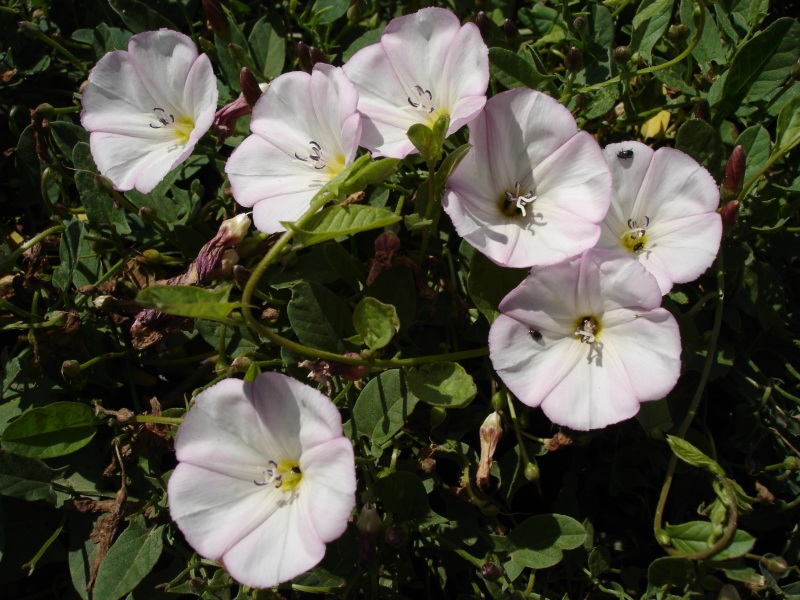
- Flowers: Funnel-shaped trumpets, roughly one to two inches long, usually light blue to purple, sometimes white or pinkish. They open in the morning and close by afternoon.
- Seeds: Round capsules hold four to six dark, wedge-shaped seeds.
Plants usually start flowering within a month or two of sprouting and keep going until frost.


Where it grows in Pennsylvania
Ivyleaf morningglory has long been a bigger problem in southern states, but it’s well known in Pennsylvania crop fields and gardens too. In central PA, it shows up most often in vegetable gardens, sweet corn and pumpkin patches, field edges, fence rows and sunny landscape beds.
It emerges later than many weeds and keeps coming up all summer, often in flushes after a good rain in June and July. That long emergence window is why a garden that looked clean in May can be tangled by August. Seeds move around with soil, manure, compost, hay and equipment, so new beds built with brought-in soil are a common starting point.
Ivyleaf morningglory look-alikes
The big one to rule out is field bindweed, a perennial with deep, creeping roots. Bindweed has arrowhead-shaped leaves, smaller white or pale pink flowers, and comes back from roots every year. Hedge bindweed has big white or pink trumpets and smooth arrowhead leaves.
Tall morningglory looks similar but has heart-shaped leaves without lobes. Wild buckwheat has heart-shaped leaves too, plus a papery sheath at each leaf joint and tiny greenish flowers instead of trumpets.
When in doubt, dig gently at the base. A single thin taproot means morningglory. White, spaghetti-like roots running off sideways mean bindweed, which calls for a longer-term plan.
How to get rid of ivyleaf morningglory
This is a weed where pulling it yourself really works, if you start early and stay consistent. Since it’s an annual, a seedling pulled out by the root is gone for good.
- Hand-pull or hoe: Remove seedlings while they’re small, before they twine onto your plants. Shallow hoeing works well in garden rows.
- Untangle carefully: Once a vine has wrapped around tomatoes or shrubs, cut it at the base and let the top die before pulling it off. Bag any vines with flowers or seed capsules.
- Mulch: A thick layer of mulch slows seedlings, but the large seeds can push through thin mulch, so keep it around three inches deep.
- Chemical: In lawns, broadleaf products with 2,4-D, dicamba or triclopyr control morningglory seedlings. In beds, glyphosate can be used as a careful spot treatment on vines that are not touching desirable plants. Many common preemergence products are weak on large-seeded weeds like morningglory.
Always read and follow the product label (the label is the law), and check that it’s labeled for your site, whether that’s a lawn, landscape bed or vegetable garden. Applying herbicide for hire in Pennsylvania requires a PA Department of Agriculture pesticide applicator certification, so larger jobs go to a licensed lawn-care company.
Keeping it from coming back
The key is never letting it set seed. Walk your garden every week or two from June through September and pull new seedlings while they’re tiny. Even late in the season, cut any vines that are flowering.
Keep beds mulched, don’t leave soil bare between crops, and be careful with compost or fill dirt from unknown sources. Because the seeds last for years, expect it to take several seasons of steady attention before you see real progress.
If a fence line or trellis next to the garden is where the vines always start, keep a mowed or mulched strip along it. That gives you one easy place to spot and pull seedlings before they climb.
Questions we get about ivyleaf morningglory
Is ivyleaf morningglory the same as bindweed?
No. Both twine and have trumpet flowers, but morningglory is an annual that grows only from seed. Bindweeds are perennials with creeping roots that come back every year.
Will it come back next year if I pull it?
The plants you pull won't come back. New ones will sprout from seed already in the soil, which is why stopping it from flowering matters so much.
Are morningglory seeds poisonous?
Morningglory seeds can be toxic if eaten, so keep them away from kids and pets. The leaves and vines aren't a skin hazard.
Weeds taking over a bed, slope or wet spot?
If vines have overrun a garden or shrub bed, Muthler can clear and renovate the bed and lay fresh mulch to help keep seedlings down. We rebuild beds, regrade and drain wet ground, clear overgrown brush and build patios and walls across Clinton, Lycoming, Centre and Union counties.
Get a free estimate(570) 397-9800Similar weeds


Further reading: Penn State Extension
Herbicides: always read and follow the product label. Applying pesticides for hire in Pennsylvania requires PA Dept. of Agriculture certification.