Purple Deadnettle
Home / Weed identification / Purple Deadnettle
Pennsylvania weed ID · Lawn broadleaf
Purple Deadnettle
Lamium purpureum · Lamiaceae (mint family)
- Winter annual
- Broadleaf
- Non-native
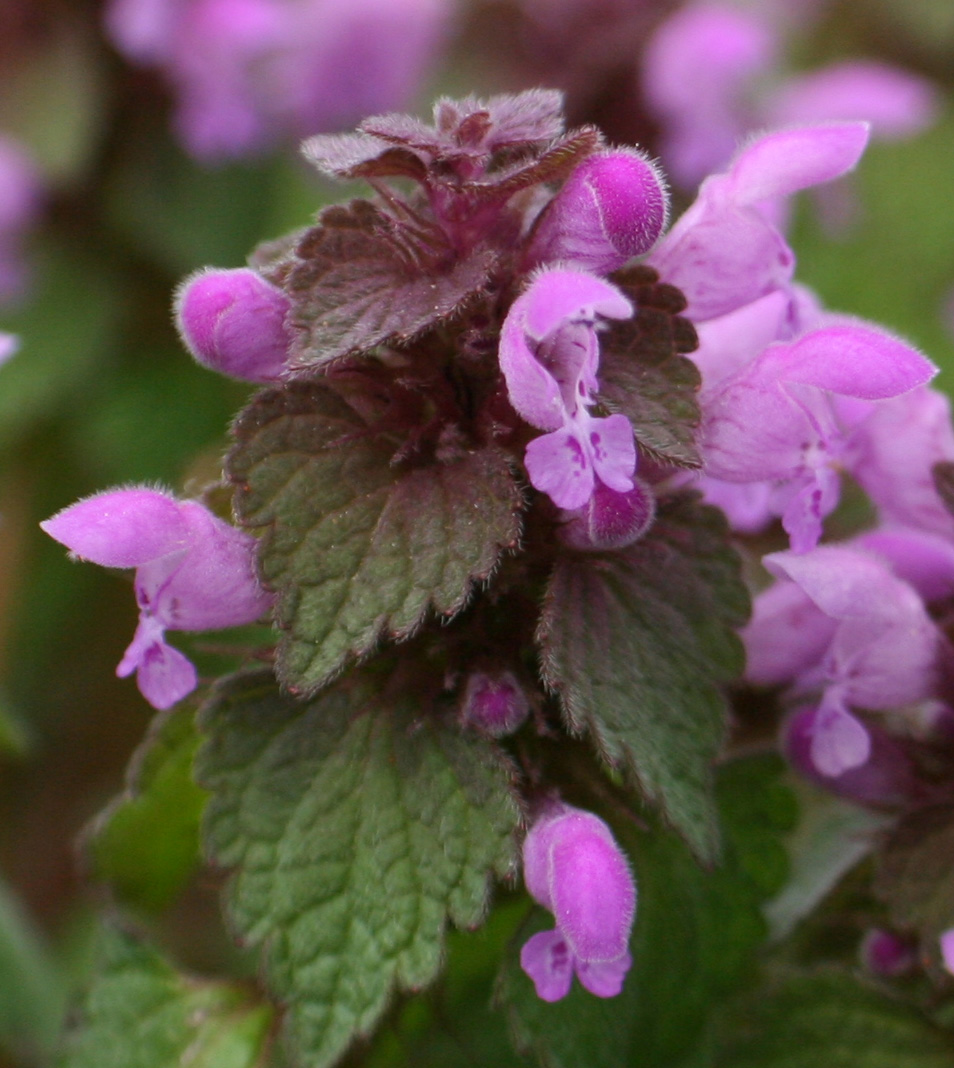
If patches of your lawn or garden turn purple in April, with fuzzy, pointed leaves on short square stems, it's purple deadnettle.
How to get rid of itAll weeds A–Z
What is purple deadnettle?
Purple deadnettle is a winter annual in the mint family that turns lawns, gardens and fields purple every spring. Purple deadnettle identification is mostly about telling it apart from henbit, a close cousin that looks very similar and shows up at the same time.
Despite the name, it doesn’t sting. The “dead” means it lacks the stinging hairs of true nettles. It sprouts in fall, spends the winter small, then grows and blooms fast in early spring.
By early summer it’s done. That’s why spraying it in May mostly wastes money; it’s already on its way out.
Purple deadnettle identification: what to look for
Look at a patch in April:
- Stems: square in cross-section, like all members of the mint family. Roll one between your fingers and you’ll feel the corners.
- Leaves: opposite, heart- to triangle-shaped, with scalloped edges and soft hairs. They crowd toward the top of the stem like a little pagoda, and the upper leaves turn purple-red.
- Leaf stalks: even the upper leaves sit on short stalks. This is the easiest way to tell it from henbit.
- Flowers: small, pink-purple, tube-shaped flowers about half an inch long, tucked among the purplish top leaves from March into May.
- Growth: low, spreading patches, 4 to 10 inches tall, from shallow, fibrous roots.
Where it grows in Pennsylvania
Purple deadnettle grows statewide in lawns, garden beds, vegetable plots, crop fields and roadsides. It’s most common where the ground was bare or thin in fall, when the seeds sprout.
In central PA you’ll often see whole farm fields glowing purple in April before planting. In yards, it shows up in thin lawn areas, newly seeded spots, garden beds left bare over winter and along bed edges. It tolerates sun or part shade and many soil types.
A mild winter gives it a head start. Plants that sprouted in October can sit through freeze-thaw cycles under a little snow cover and be ready to bloom the first warm week of March, long before your lawn grass starts growing.
Purple deadnettle look-alikes
A few spring weeds in the mint family look alike:
- Henbit is the closest look-alike. Its upper leaves are rounder and more deeply scalloped, and they wrap around the stem with no stalk. Its pink flowers have a longer, slimmer tube and rise above the leaves.
- Creeping Charlie (ground ivy) is a creeping perennial with round, scalloped leaves, blue-purple flowers and a strong minty smell when crushed. It stays green through summer.
- Heal-all has square stems too, but it blooms in summer with lance-shaped leaves and short purple flower spikes.
Deadnettle and henbit are controlled the same way, so if you can’t tell them apart, it won’t change your plan.
How to get rid of purple deadnettle
Hand and mechanical. In beds and small lawn patches, pull or hoe it before it sets seed in late spring. The roots are shallow, so plants come up easily. Shake off the soil and toss them in the compost if they haven’t flowered yet; bag them if they’re already setting seed. Regular mowing in spring at 2 to 3 inches removes many of the flowering tops and cuts down on seed.
Cultural. This is a weed of thin turf and bare soil. Overseed and fertilize your lawn in late summer and early fall so the grass is thick when the deadnettle seeds sprout. In beds and gardens, mulch 2 to 3 inches deep or plant a cover crop so soil isn’t bare over winter.
Chemical. Timing is everything. Penn State Extension notes that a preemergence herbicide applied in early to mid-September can stop seeds from sprouting, but it also stops grass seed, so don’t use one where you plan to overseed. If you miss that window, a postemergence broadleaf herbicide in October or November, while plants are small and actively growing, works far better than a spring application. Extension turf programs list broadleaf combination products containing 2,4-D, dicamba, MCPP, MCPA, fluroxypyr, triclopyr, quinclorac, sulfentrazone or carfentrazone. By late spring, plants are already dying back on their own.
Read and follow the product label, because the label is the law, and confirm it’s labeled for your site and type of grass. Applying herbicide for hire in Pennsylvania requires a PA Department of Agriculture pesticide applicator certification, so larger lawn programs should go to a licensed lawn-care company.
Keeping it from coming back
The best prevention is a thick lawn in September and October, when seeds sprout. Overseed thin areas in late summer, mow at 3 to 3.5 inches through fall and fertilize mainly in fall.
Keep garden soil covered over winter with mulch or a cover crop, and edge beds cleanly so weeds don’t creep in. A fresh layer of mulch in fall goes a long way.
Some homeowners leave a few patches in out-of-the-way spots. The early flowers feed honey bees and bumble bees when little else is blooming.
Questions we get about purple deadnettle
Does purple deadnettle sting?
No. The "dead" in the name means it doesn't have the stinging hairs of true nettles. It's soft and fuzzy to the touch.
What's the difference between purple deadnettle and henbit?
Purple deadnettle's upper leaves are triangle-shaped, purplish and on short stalks. Henbit's upper leaves are round, deeply scalloped and wrap around the stem with no stalk. Both are controlled the same way.
Should I spray purple deadnettle in spring?
Usually not. By the time it's blooming, it's close to the end of its life. Fall is the time to treat it, and a thick lawn going into fall is the best prevention.
Weeds taking over a bed, slope or wet spot?
If bare garden beds keep filling with spring weeds, Muthler can renovate and mulch them so there's less open soil each fall. We rebuild beds, regrade and drain wet ground, clear overgrown brush and build patios and walls across Clinton, Lycoming, Centre and Union counties.
Get a free estimate(570) 397-9800Similar weeds
 HenbitLamium amplexicaule
 Creeping Charlie (Ground Ivy)Glechoma hederacea
 Common ChickweedStellaria media
Further reading: Penn State Extension
Herbicides: always read and follow the product label. Applying pesticides for hire in Pennsylvania requires PA Dept. of Agriculture certification.