Creeping Buttercup
Home / Weed identification / Creeping Buttercup
Pennsylvania weed ID · Lawn broadleaf
Creeping Buttercup
Ranunculus repens · Ranunculaceae (buttercup family)
- Perennial
- Broadleaf
- Non-native
- Toxic / hazard
If the soggy low spot in your lawn is turning into a mat of shiny yellow flowers and creeping runners, you've likely got creeping buttercup.
How to get rid of itAll weeds A–Z
Creeping buttercup is mildly poisonous when fresh. Don't let kids or pets chew on it, and wear gloves if you're pulling a lot of it, since the sap can redden or blister sensitive skin. Wash your hands afterward.
What is creeping buttercup?
Creeping buttercup identification is worth getting right because the plant is also a soil report. It’s a low perennial from Europe and Asia that loves wet, poorly drained ground, and it spreads across lawns on rooting runners the way strawberries do.
A few plants are nothing to worry about. But once it gets going in a damp yard, it can push out grass in sizeable patches, and the runners make it harder to pull than the upright buttercups you see in pastures.
It’s a cousin of the tall meadow buttercup you see in pastures, and like the rest of the family it contains a bitter irritant when fresh. That keeps grazing animals away from it, which is part of why it gets so thick in damp horse paddocks and backyards alike.
Creeping buttercup identification: key features
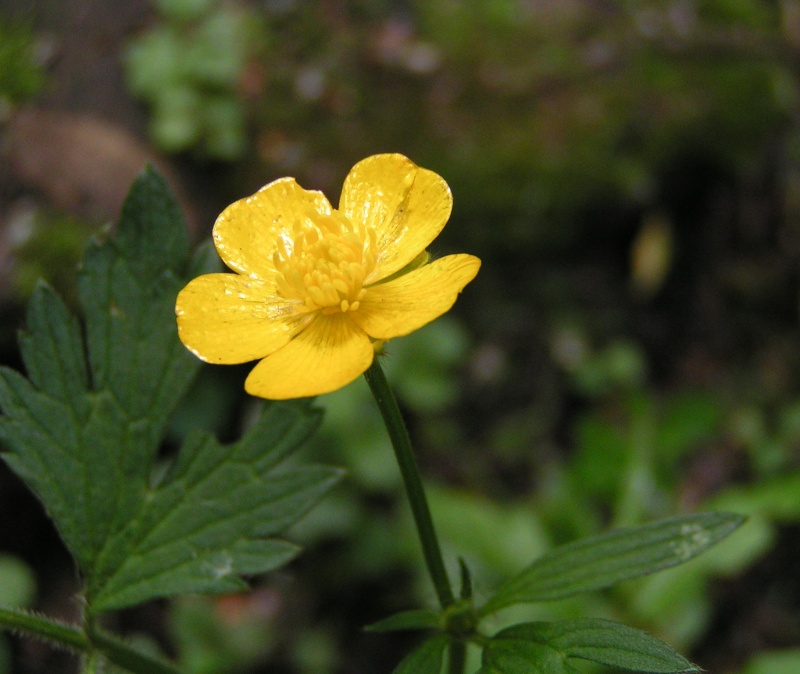
Start with the leaves. They’re dark green, often glossy and frequently marked with pale spots or blotches. Each leaf is split into three toothed leaflets, and the middle one usually sits on its own short stalk.
- Runners: long, low stems that lie on the ground and put down roots and a new tuft of leaves at each joint.
- Flowers: very shiny, almost lacquered yellow cups, about half to three-quarters of an inch across, usually with five rounded, overlapping petals. Penn State notes they bloom mostly in May and June.
- Stems: leaf and flower stalks are a little hairy and turn red or purple near the crown.
- Roots: fibrous and fairly shallow, no taproot.
In early spring, before flowers appear, look for the spotted three-part leaves in a low rosette with thin runners already reaching out across the soil. Turn back a handful of grass and you’ll often find the runners stitched through the thatch, rooting every few inches. That network is why one plant turns into a patch so quickly.
Where it grows in Pennsylvania
Water is the main clue. Creeping buttercup thrives in soggy lawns, low areas where downspouts dump, the bottom of a slope, ditches and stream banks. It handles sun or shade and is common on heavy clay that stays wet after rain, which describes plenty of yards in our river valleys.
If it’s thickest right where water sits after a storm, that’s not a coincidence. Thin turf on wet ground gives the runners room to move.
We also see it along the edges of wooded lots where the ground stays damp and shaded, and in yards where a sump pump or downspout outlet empties onto the grass. Compacted soil that sheds water slowly makes the problem worse, because the surface stays saturated long after the rain stops.
Creeping buttercup look-alikes
Lesser celandine is the big one in PA. It also has glossy yellow flowers and loves damp ground, but its leaves are heart-shaped and undivided, its flowers have eight to twelve narrow petals, and it disappears by early summer.
Mock strawberry creeps with runners and has three leaflets, but it makes little red fruits and its flowers sit above leafy green bracts. Yellow wood sorrel has heart-shaped, folding leaflets and plain flat flowers.
How to get rid of creeping buttercup
Plan on two fronts: remove the plants, and fix the wet conditions that let them win.
- Dig it out: for small patches, loosen the soil with a garden fork and lift the whole crown and its runners. Follow each runner to its rooted daughters. Moist soil makes it easier. Gloves are a good idea.
- Fix drainage: Penn State lists improving drainage and cutting back on irrigation as key steps. Redirect downspouts, fill low spots, or regrade so water moves off the lawn. For a spot that never dries out, a French drain may be the honest answer.
- Aerate: core aerating compacted clay in early fall helps water soak in instead of sitting on top, and gives new grass seed a better seedbed.
- Thicken the turf: fertilize properly, mow at 3 to 3.5 inches and overseed thin areas in early fall with grasses suited to damp or shady sites.
Herbicides: broadleaf lawn products can suppress or control creeping buttercup when it’s actively growing in spring or early fall. Labeled active ingredients include combinations of 2,4-D, dicamba, MCPP, MCPA, triclopyr and fluroxypyr, plus products containing mesotrione, quinclorac or sulfentrazone. Expect a follow-up treatment. Read and follow the label every time, since the label is the law, and use extra care near streams, ponds or ditches; many products aren’t labeled for use near water. Applying herbicide for hire in PA requires a PA Department of Agriculture pesticide applicator certification, so larger areas go to a licensed lawn-care company.
Keeping it from coming back
If the ground stays soggy, creeping buttercup will keep finding its way back no matter how often you pull or spray. Drainage is the real fix. Once water moves off the area, grass can compete again and the buttercup loses most of its edge.
Check the area each spring for new runners creeping in from the edges and pull them while they’re small. Keep the turf dense so there’s no open soil for seedlings.
Don’t expect it to vanish in one season. Runners hiding in the thatch and seed in the soil will produce a few new plants for a while. A quick look each spring and fall, and pulling stragglers while they’re small, keeps a cleared area clean.
Questions we get about creeping buttercup
Is creeping buttercup poisonous to dogs?
Fresh buttercups contain an irritant that can cause drooling, mouth irritation and upset stomach if chewed. Most animals avoid it because it tastes bitter. Call your vet if a pet eats a lot.
Why is creeping buttercup taking over my lawn?
It's a sign of wet, poorly drained soil and thin grass. Fixing drainage and thickening the turf is what keeps it from returning.
Can I just mow creeping buttercup?
Mowing won't kill it. The runners lie below most mower blades. Dig out small patches, fix the drainage and treat larger areas with a labeled broadleaf product.
Weeds taking over a bed, slope or wet spot?
If buttercup is marking a wet spot that never dries out, Muthler can regrade the area or install a French drain so water leaves the lawn and grass can take it back. We rebuild beds, regrade and drain wet ground, clear overgrown brush and build patios and walls across Clinton, Lycoming, Centre and Union counties.
Get a free estimate(570) 397-9800Similar weeds
 Lesser CelandineFicaria verna
 Mock StrawberryPotentilla indica
 Creeping Charlie (Ground Ivy)Glechoma hederacea
Further reading: Penn State Extension
Herbicides: always read and follow the product label. Applying pesticides for hire in Pennsylvania requires PA Dept. of Agriculture certification.