Introduction: Pennsylvania’s landscape is known for rolling hills, lush greenery, and unfortunately, clay-heavy soils that often spell trouble for drainage. Homeowners and contractors across the state – from the suburbs of Philadelphia to rural Central PA and the hills of Pittsburgh – grapple with water pooling in yards, flooded basements, and foundation damage due to inadequate drainage in clay soil. Clay-rich earth doesn’t let water pass through easily, so heavy rain or snowmelt can turn a yard into a muddy mess or send water seeping into the foundation[1][2]. This guide will explain why Pennsylvania’s clay soil presents unique drainage challenges and walk you through effective yard and foundation drainage solutions. We’ll cover how to assess drainage problems, methods like French drains, re-grading, downspout extensions, sump pumps, surface drains, and soil amendments, plus cost considerations, maintenance tips, and when to call a professional Pennsylvania drainage contractor for help. By the end, you’ll know how to achieve a dry yard and a protected foundation – even in stubborn clay soil.
The Problems with Poor Drainage in Clay-Rich Soils

When a yard has poor drainage – a common issue in areas with dense clay soil – a host of problems can crop up. What starts as a simple puddle can lead to persistent yard flooding and even structural damage if left unaddressed. Here are some of the common issues caused by inadequate drainage in clay-heavy Pennsylvania soils:
- Standing Water & Yard Flooding: Heavy clay soil tends to hold water on the surface. After rain, you might see large puddles that linger for days, or even inches of water that “just sit” until they finally evaporate. Besides turning your lawn into a slimy, unusable mess, standing water can drown grass and landscape plants and create a soggy lawn that’s unpleasant to walk or play on[1][3]. Homeowners in clay-rich areas of PA have reported that several inches of rain can pool in their yards with nowhere to go. This isn’t just an eyesore – it’s often the first sign of bigger issues.
- Mosquitoes and Pests: Stagnant puddles are a breeding ground for mosquitoes and other pests. If your yard stays wet, you may notice an uptick in mosquitoes (raising health concerns like West Nile virus) and even pests attracted to the moisture. Nobody wants their backyard BBQ ruined by swarms of bugs. Standing water “creates the ideal setting for mosquito breeding”[4], so fixing drainage improves your outdoor comfort and safety.
- Soil Erosion & Landscape Damage: Poor drainage can wash away topsoil and mulch. When water can’t soak into clay ground, it tends to run off quickly, carving channels and eroding soil. You might find flower beds or sections of lawn get scoured out after storms. Erosion not only ruins your landscaping efforts but can also undermine patios, walkways, or driveways over time[3]. In heavy downpours, mulch from your gardens might float away and bare soil can be left behind.
- Plant Stress & Turf Problems: Clay soil that stays waterlogged will suffocate plant roots. Oxygen can’t penetrate saturated soil, so grass and garden plants develop root rot or simply drown. You may see unhealthy, yellowing grass or dead patches in areas where water pools. Trees and shrubs in poorly drained spots can also suffer. Conversely, when that clay finally dries, it can become rock-hard, further stressing roots. Proper drainage keeps your lawn and garden healthier[3] by preventing the cycle of drowning and drying out.
- Basement Leaks and Foundation Damage: Perhaps the most serious issues occur around your foundation. Excess water pooling near the house will eventually find its way inside or push against the structure. In Pennsylvania’s climate, spring rains and snowmelt can saturate the ground and lead to water seeping into basements or crawl spaces. You might notice a damp basement wall, minor leaks, or even significant flooding after storms if drainage is bad. Over time, constant moisture against the foundation causes mold, mildew, and decay – and it increases hydrostatic pressure on the foundation walls[5]. That pressure can cause cracks in basement walls, bowing or bulging walls, and in extreme cases even wall collapse if not relieved[5]. Foundation problems like cracking, settlement, or shifting are often tied to poor drainage and clay soil expansion[6].
- Overworked Sump Pumps: Many Pennsylvania homes have sump pump systems to keep basements dry. Poor yard drainage means that sump pump runs constantly as water keeps pooling around the foundation. An overworked sump can burn out or fail, leading to basement flooding. In fact, yards that don’t drain well are a common cause of premature sump pump failure[7]. If you hear your sump running frequently even when it hasn’t rained recently, it might be because groundwater isn’t draining away and is continually triggering the pump.
- Mold & Mildew: Chronically damp conditions (in the yard and in basements) create a perfect environment for mold. You might find mold in crawl spaces, on basement walls, or even in living areas if moisture migrates upward. Mold remediation can be costly, and it poses health risks. Fixing drainage helps keep your home dry and mold-free[8].
- Reduced Usability & Property Value: A yard that’s always muddy is basically unusable – children and pets can’t play without getting covered in muck, and you can’t mow or enjoy the lawn. This not only robs you of enjoying your property, but it can also hurt curb appeal. Prospective buyers see a swampy yard or water-stained foundation as a red flag. In contrast, a dry, well-drained property is more attractive and retains value. As one local expert noted, a soggy, muddy lawn is a red flag to buyers, whereas a professionally drained yard adds instant value to your property[9].
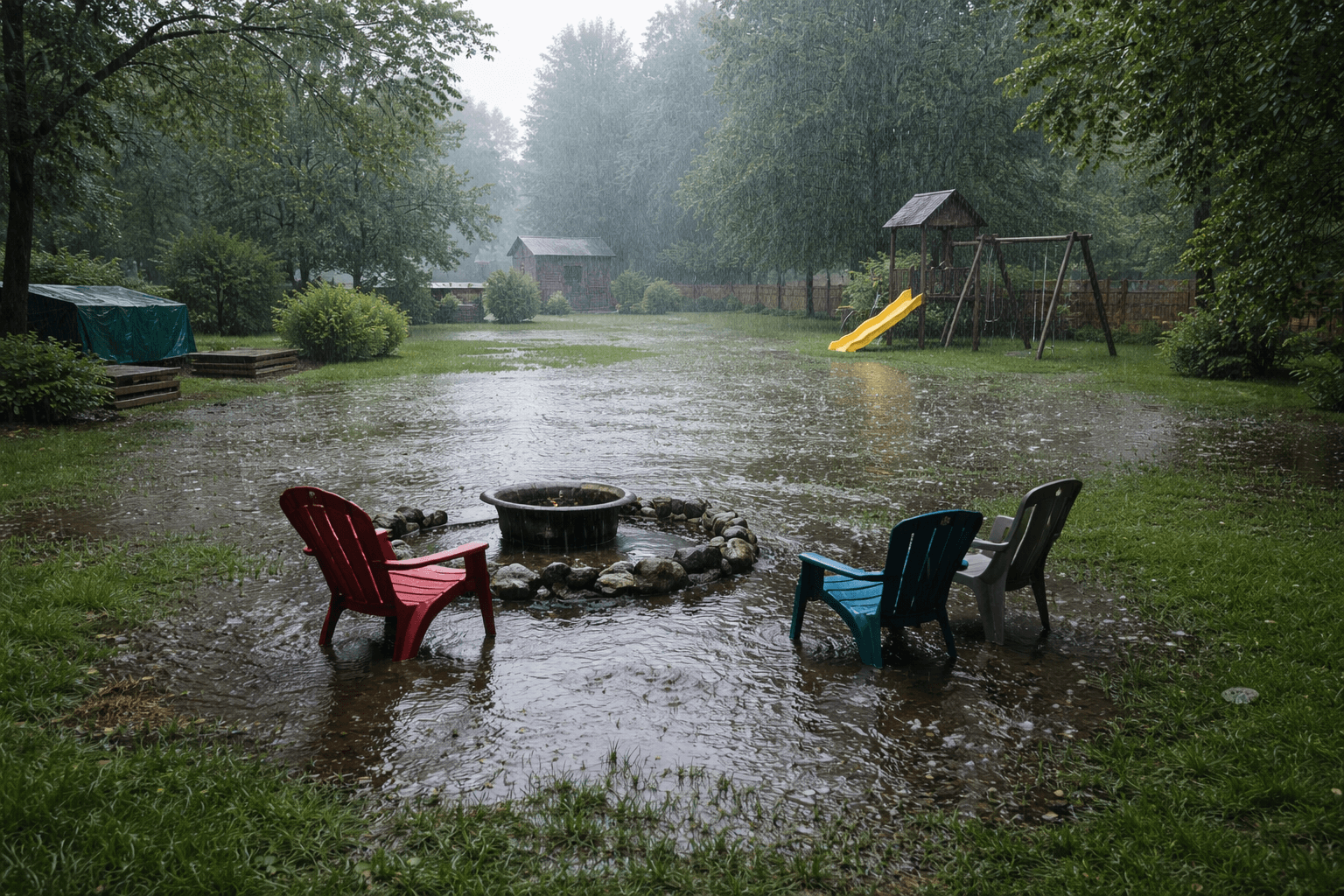
Standing water in a Pennsylvania yard after spring rain. Clay-heavy soil doesn’t absorb water quickly, leading to persistent puddles that can kill grass, attract pests, and strain your home’s foundation.
In short, poor drainage in clay soil is more than just an inconvenience – it can trigger a domino effect of damage. Water pooling on the surface can lead to erosion, which exposes the foundation and causes cracks, which then lead to leaks, mold, and even structural instability[10]. Fortunately, these problems can be prevented by implementing the right drainage solutions for your yard and foundation.
Why Clay Soils Drain Poorly (and Why It Matters in PA)

Clay is often the culprit behind drainage issues in Pennsylvania. But what makes clay-heavy soil so troublesome? The answer lies in its unique characteristics. Clay soil particles are extremely small and pack tightly, leaving little pore space for water to flow through. In practical terms, clay soil has low permeability, so water cannot easily pass through it[11]. Instead of soaking in quickly, rainwater tends to accumulate in clay, causing that waterlogged, squishy ground we’re all familiar with.
Here are the key properties of clay soil that impact drainage and foundations:
- Density and Low Permeability: Clay-rich soils are dense and compact by nature. When it rains, water hits the surface and struggles to infiltrate. This leads to surface pooling and runoff because the tight soil structure acts almost like a plastic liner. A technical paper on Western Pennsylvania soils notes that the region’s prevalent clay from weathered shale is slow-draining and prone to water buildup in the soil[12][11]. So, if your property sits on clay (common in many PA areas), expect that water will linger unless you actively direct it away.
- Expands When Wet, Contracts When Dry: Clay doesn’t just hold water – it reacts to it. When clay soil absorbs moisture, the clay particles actually swell in size. This can be a significant force. The expansion pushes against anything in its way, including your foundation walls. This phenomenon (part of what engineers call hydrostatic pressure) can cause or widen cracks in foundations and basement walls[13][14]. Then, when dry weather comes, the clay shrinks and contracts, sometimes pulling away from foundation walls and creating gaps in the soil. These gaps become pathways where the next heavy rain will rush in, starting the cycle over again[14]. So the expand-contract cycle of clay soil puts repetitive stress on structures and can lead to instability or leaks.
- Heavy Weight When Saturated: Water is heavy, and waterlogged clay soil is extremely heavy. Saturated clay around a house can put additional load on foundation walls. One expert pointed out that when clay soils become soaked, they get “extremely heavy and dense,” adding a great deal of stress that can contribute to foundation settling or even collapse in extreme cases[15]. Imagine hundreds of gallons of water trapped in the soil around your basement – that weight is constantly pushing against your home’s walls.
- Poor Soil Structure & Compaction: Clay’s tiny particles not only slow drainage but also compact easily. In many Pennsylvania yards, years of foot traffic, lawn equipment, or construction have further compacted clay soils, squeezing out any little air pockets that might have helped drainage. Poorly structured clay doesn’t have the helpful aggregate (crumb-like) structure that looser soils have[16]. As a result, it’s even more prone to settling and cracking, and less able to handle water. Once compacted, clay soil will channel water along the surface (often toward the lowest spot – which could be your foundation or a corner of the yard).
- Freeze-Thaw Cycles: Pennsylvania experiences all four seasons, including cold winters. Clay soil is sensitive to freeze-thaw: water in the soil freezes and expands, then thaws and contracts. Each freeze-thaw cycle can shift soil slightly. In clay, this means additional expansion and contraction beyond the normal moisture changes[17]. Over years, freeze-thaw can contribute to uneven settlement of clay soil and open up more spaces for water to penetrate. This is one reason we see seasonal foundation movement or new cracks appearing after winter in clay-heavy regions.
- Geographic Prevalence: Clay soil isn’t confined to one corner of PA – it’s found in various regions. Western Pennsylvania (e.g. Pittsburgh and surrounding counties) has predominantly clay-rich soils derived from shale, as noted above[18]. In these areas, dense clay and hilly terrain make drainage a constant challenge. Eastern Pennsylvania isn’t off the hook either: parts of Bucks County and the Delaware Valley have clay and silt loam soils that behave like clay, expanding when wet and causing foundation pressures[13]. Central PA can have heavy clay subsoil in river valleys or wherever there’s poor natural drainage. The key point is that no matter where you are in Pennsylvania, if your soil is clay-heavy, you must take drainage seriously. As a local landscaping company put it, living in regions with “rain, snowmelt, and clay-heavy soils” makes proper drainage not a luxury – but a necessity[2].
Understanding the nature of clay soil underscores why the drainage solutions we’ll discuss are so important. If you have clay soil, you simply can’t rely on the ground to absorb water quickly on its own. You have to actively manage runoff and groundwater. The silver lining is that with proper design – things like foundation drains, graded slopes, and soil improvements – it’s entirely possible to mitigate clay’s bad behavior[19]. In fact, engineers and contractors routinely design foundation drainage solutions specifically to handle clay conditions, using a combination of exterior drains, interior drains, and careful soil prep to keep structures safe[20]. So, don’t despair if you have “that awful Pennsylvania clay” – with the right approach, you can achieve a dry yard and a stable foundation.
Assessing Your Yard’s Drainage Problems

Before jumping into fixes, it’s important to evaluate how and where water is causing trouble on your property. Both homeowners and contractors should start with a thorough assessment of drainage patterns. Here’s how to identify problem areas and gauge the severity of your drainage issues:
- Look for Standing Water After Rain: The most obvious sign is puddles or soggy areas that remain well after a storm. Walk your property a day or two after heavy rain. Do you find sections of the lawn that are still squishy or have visible water? Take note of any spots where “water can sit until it is evaporated,” as that indicates zero infiltration. Common places to check are low spots in the yard, areas along fence lines or between houses (where clay soil compaction and lack of sun slow drying), and around the foundation. Even a shallow depression can collect a lot of water if the soil won’t drain.
- Check the Foundation Perimeter: Walk around your house’s exterior. Is the soil right next to the foundation damp or muddy long after rain? Are there water stains, moss, or efflorescence (white mineral deposits) on the bottom of foundation walls? Those are signs water has been pooling there repeatedly. Also inspect your basement or crawl space interior for any signs of moisture ingress – such as damp concrete, dark patches, moldy smells, or active drips. If you see water inside after rain, that’s a glaring sign of drainage failure outside.
- Inspect Gutters and Downspouts: Sometimes drainage issues start from above. During a moderate rain, observe your gutters – are they overflowing? Clogged or undersized gutters will dump water straight down the walls. Similarly, note where each downspout releases water. If downspouts end right at the foundation or only extend a foot or two, you can almost guarantee water is pooling at the foundation in clay soil. A proper setup should carry water several feet away (6+ feet) from the house[21]. In assessing your drainage, mark any downspouts without extensions or with extensions that lead to problematic areas.
- Identify Erosion or Surface Channels: Look for streaks of displaced soil or mulch, rills in the lawn, or exposed roots – these indicate running water. In clay soil yards, you might see that water has been skimming off the surface and cutting paths. Note if these erosion channels lead toward the house or to low spots. This mapping will tell you how water is naturally trying to flow and where it’s getting stuck.
- Note Landscaping and Soil Condition: Hard, compacted ground or lots of clay fill (often visible as hard, cracked soil in dry times) means poor infiltration. If you have areas of the yard where grass struggles to grow and the soil is like concrete when dry, that’s likely a drainage trouble spot when wet. Also, large paved areas (driveways, patios) or roof areas might be sending extra runoff to certain sections – figure out where that water goes.
- Check for Sump Pump Activity: If your home has a sump pump, monitor it. Does it run frequently, even during moderate rain or long after rain stops? Constant sump activity could mean groundwater is not draining away due to the clay soil. Some homeowners discover their sump runs non-stop because downspout water or yard water is cycling right back into the foundation area. If you can, also check where your sump pump discharges outside – if it’s too close to the house, the water may be percolating back to the basement (a “recycling” issue noted by engineers)[22].
- Document Problem Times: Is the issue year-round or seasonal (e.g. only in spring thaw or after a big storm)? Clay soil yards often have the worst problems in spring when snowmelt saturates the ground and spring rains fall on already wet soil. Knowing when issues peak can help tailor the solution (for instance, ensuring a drainage system can handle spring volumes).
- Use the Hose Test (if needed): If you’re unsure about a particular area, you can simulate heavy rain. For example, if you think a certain spot might not drain, saturate it with a hose for 15-20 minutes and see how long the water remains. This can reveal hidden low spots or confirm that clay soil is causing slow percolation.
By thoroughly assessing these factors, you can pinpoint where intervention is needed – whether it’s at the yard level (surface water management) or at the foundation level (keeping water out of your basement), or often both. It might help to sketch a simple map of your property, marking wet areas, water flow directions, and structures. Contractors often do a similar survey when providing estimates, checking the grading, soil type, and water entry points. If the problems seem minor and localized, you might tackle them DIY; but widespread pooling or any signs of foundation stress call for robust solutions and possibly professional guidance.
Next, we’ll explore effective drainage solutions that work for Pennsylvania’s clay soils – from time-tested methods like French drains to simple fixes like extending a downspout. Often, the best approach will combine several of these solutions for a comprehensive fix.
Effective Drainage Solutions for Clay Soil in Pennsylvania

Draining a yard with clay soil isn’t a one-size-fits-all job. The right solution (or combination of solutions) depends on your specific situation – soil composition, yard slope, water volume, and whether you’re protecting a foundation or just drying out a lawn. In many cases, multiple strategies work together to keep your property dry[23]. Below, we outline the most effective drainage solutions for clay-heavy yards and foundations, with a focus on their use in Pennsylvania’s climate and soil conditions:
1. French Drains
A French drain is one of the most popular and effective solutions for yards with poor drainage – especially in clay soil. A French drain is essentially a gravel-filled trench containing a perforated pipe that collects and redirects water. It’s usually installed just below the surface, either in trouble spots in the yard or around the perimeter of a foundation. As water in the soil finds the gravel trench, it flows into the pipe and is carried off to a discharge point away from the home (such as a lower area of the yard, a storm sewer, or a dry well)[24][25].
Installing a French drain in clay soil: a trench is lined with fabric, filled with gravel, and contains a perforated pipe. This subsurface system intercepts water before it can pool on the lawn or seep into the foundation.
French drains are especially well-suited for clay soil because they create an artificial pathway for water in a place where the native soil isn’t providing one. Instead of water sitting on impermeable clay, it finds the gravel (which has lots of air space) and quickly moves into the pipe. Many homeowners opt for French drain installation in PA as a go-to yard drainage fix, but there are a few important considerations:
- Proper Installation is Critical: Clay soil presents unique challenges for French drains. If not done right, the drain can clog or fail in a few years. The trench should be dug to an appropriate depth (often 18-24 inches for yard drains) with a consistent slope (generally about 1% to 2% grade, e.g. a 1 inch drop per 8 feet[26]). A layer of geotextile filter fabric is typically used to line the trench and wrap over the gravel and pipe. This filter is vital in clay soils – it keeps fine clay particles out of the perforated pipe and gravel bed[27][28]. Without a good fabric or sock on the pipe, clay sediment can clog the system over time. Using coarse washed gravel (not sand or dirt) around the pipe is equally important to promote flow and avoid compaction[29][30].
- Placement and Design: Identify where the water is coming from and where it should go. For example, if your backyard has a low spot that floods, a French drain might encircle that area and then run downhill to daylight farther away. If the goal is protecting a foundation, a French drain (sometimes called a “footing drain” when right at the foundation) might be installed along the perimeter of the house to intercept water before it enters the basement. Always ensure the outlet of the French drain is well away from any building – ideally at a lower elevation part of your property or into a storm drain if local codes allow.
- Benefits for Foundations: French drains relieve the hydrostatic pressure that builds up in waterlogged clay soil around foundations[19]. By giving water an easy escape route, they reduce the pressure that would otherwise push against your basement walls. In many Pennsylvania homes with clay soil, installing an exterior French drain has been a successful foundation drainage solution to keep basements dry[31][32]. Interior French drains (along the inside of the basement perimeter leading to a sump pump) are another approach when exterior excavation is difficult, though those manage water after it enters, rather than before.
- Combine with Sump Pump if Needed: If your property is flat or if the French drain can’t daylight by gravity, you may need to route it to a sump pit and pump the water out. This is common in areas with a high water table or very flat yards. The French drain feeds the sump, and the sump pump actively discharges water to a safe location (like a storm sewer or downhill area). Many modern drainage solutions in clay soil use a combo of French drains plus sump pumps for reliability[33].
- Longevity and Maintenance: A well-built French drain using quality materials can function for decades, but some maintenance helps. Inspection ports can be installed to check for sediment buildup, and occasionally flushing the line with clean water can clear minor clogs. Ensure the drain’s outfall (the exit point) remains free of debris and vegetation – you don’t want the end of your drain to get blocked. Because French drains in clay can eventually get silted, keep an eye on performance: if you notice the yard is puddling like before, the system may need a check or clean-out. On the upside, newer geotextile fabrics and improved pipe designs have made French drains more resistant to clogging by clay particles[27][34] than older styles.
French drains are a cornerstone of yard drainage in PA. Whether installed DIY or by a pro, they are highly effective at drying out saturated soil and protecting foundations when designed for the soil conditions. Just remember: a French drain only works if it’s put in correctly and in the right place – an improperly sloped or poorly filtered drain won’t solve the problem[23]. If in doubt, consult with a drainage contractor experienced in French drain installation in PA clay soils to get it right the first time.
2. Surface Grading and Re-Sloping
Sometimes, the simplest solution is the most powerful: regrading the land so that water flows away by gravity. Proper grading is fundamental in any drainage plan – think of it as creating a gentle slope that naturally guides water off your property or at least away from trouble spots. Both homes and commercial sites should have a positive slope away from foundations and critical areas. In fact, building codes typically require that the ground around a foundation drop about 6 inches over the first 10 feet (which is a 5% grade)[35].
For Pennsylvania clay soils, grading is especially crucial because you can’t count on absorption; you need the water to run off. Here’s how to approach grading and slope fixes:
- Correct Negative Drainage: Walk around your structure and yard to identify any negative grading, where the ground actually slopes toward the house or forms a bowl. Commonly, soil may have settled right against the foundation over time, or landscaping built up soil incorrectly. These areas should be filled and contoured so that you achieve at least that minimum 5-6 inch drop over 10 feet away from the foundation[35]. In practical terms, that might mean adding clean fill soil (preferably clay-based fill that packs well) around the foundation, then topping with topsoil for planting. Ensure the slope is smooth – avoid low spots where water could sit.
- Create Swales or Shallow Ditches: In larger yards or commercial properties, swales are often used to channel water. A swale is a shallow, broad ditch that’s usually grassed or lined with stones – it’s like a gentle valley that carries runoff. If your yard is flat or you have a big area of clay that floods, carving a subtle swale can give water an easy path to a lower point or drainage outlet. For example, a swale along a property line could direct water toward the street or a storm drain. Swales are effective and low-maintenance (you can often mow over a grassed swale). Just make sure the swale actually outlets somewhere useful and doesn’t just end at your neighbor’s yard (collaborate with neighbors or tie into municipal drainage if needed).
- Build Berms or Contours: In some cases, you might raise certain areas to prevent water from reaching them. A small berm (a raised patch of land) can redirect flow. For instance, if water from a higher part of your yard is streaming toward the house, you could grade a berm to divert that flow around the house instead. Landscaping can be shaped in ways that are both functional and attractive – some projects incorporate dry creek beds or bermed planting areas that also serve to steer water.
- Consider Driveway and Hardscape Runoff: Impermeable surfaces like driveways or large roofs concentrate a lot of water. When regrading, account for these. Ensure the driveway has a slight crown or consistent slope to shed water to the sides, and from there, your grading or drains carry it away. If your driveway edges are contributing to yard puddles, you might integrate a shallow channel or curb to route that water along a desired path.
- Equipment and Disruption: Regrading often requires moving significant soil. For large jobs (like re-sloping an entire yard or around a building), using a Bobcat or backhoe is common, so this might be where a contractor is very helpful. They can reshape the land efficiently and usually laser-level the grade to ensure the slope is correct. Be prepared: regrading will disturb your lawn and landscaping, so you may need to reseed or replant areas. However, the long-term benefit of a dry property outweighs the short-term disruption.
- Clay Soil Specifics: When grading clay soil, try to avoid doing it when the soil is extremely wet (to prevent further compaction and a gooey mess). Once shaped, compact the fill gently to avoid future settling – but not so much that you create a new compaction issue. After grading, it’s wise to establish vegetation (grass or groundcover) on any bare soil to prevent erosion; mulch can help in the meantime. Remember, clay doesn’t absorb much, so the goal is to shed water off the surface. Even a moderate slope of a few percent (say 2-3% grade) can make a significant difference in directing water away rather than letting it puddle[36][37].
Grading is often Step #1 in drainage improvement. In fact, many drainage contractors will refuse to install, say, a French drain around a house if the grading is severely wrong – because grading fixes the root cause of a lot of water problems (water shouldn’t be next to your house in the first place!). In Pennsylvania’s climate, you want rain and snowmelt to flow out to the street, into swales, or to natural drainage courses, not toward your foundation or sitting on your lawn. Proper re-sloping ensures that gravity becomes your ally in drainage. It’s a long-lasting, maintenance-free solution once done: a well-graded yard will serve you well for years, only needing minor touch-ups if any settling occurs[37].
3. Downspout Extensions and Gutter Improvements
Your roof is like a giant catch-basin for rain, and all that water gets funneled to the corners via gutters and downspouts. In a heavy storm, thousands of gallons of water might come off your roof. Where that water goes is critical. If your downspouts dump it right at the foundation or into a clay soil flowerbed by the house, you’re essentially injecting water into the worst place. Ensuring proper gutter and downspout drainage is one of the simplest yet most impactful drainage fixes for both yard and foundation health.
Key steps and tips for managing roof runoff in clay soil areas:
- Extend Those Downspouts: A good rule of thumb is to have downspouts discharge at least 6 to 10 feet away from the foundation of your home[21][38]. Many homes, especially older ones, have short downspouts that end right at the base of the wall or just a couple feet out. That’s not enough, especially in clay where the water won’t just soak in. Extensions can be easily added to carry the water farther out into the yard or to a lower spot. You can use inexpensive plastic or aluminum extensions, or even bury a length of drain pipe to hide it – the key is that the water daylights well away from the house. In clay-heavy neighborhoods, contractors often tie gutter downspouts into underground PVC or corrugated drain lines that lead to a safe discharge point (like a pop-up emitter in the lawn further from the house, a storm drain, or a dry well). This keeps the yard looking neat while still moving water as required.
- Fix Gutter Issues: Check that your gutters are clean and sized appropriately. Clogged gutters will overflow, pouring water straight down walls and onto the ground near the house. Clean them at least twice a year (spring and late fall). If you have a lot of trees, gutter guards might help reduce clogs. Also, ensure the gutter system is intact – no leaks at seams, and that each downspout is actually connected. It sounds basic, but many drainage problems are simply the result of gutters detached or tipping, dumping water where it shouldn’t go. Remember that gutters and downspouts are your home’s first line of defense against water problems[21]. They collect and direct water efficiently if they’re maintained.
- Downspout Discharge Location: Where you send the water matters. If your yard is small or flat, sending a gush of roof water 6-8 feet out might still result in pooling at that spot (especially in clay soil). In such cases, consider connecting the downspout to a buried drain line that leads to a better location. Some options:
- Run it to a curb or storm sewer (check local regulations; some cities allow direct connections, others don’t).
- Discharge to a dry well – basically an underground gravel pit or plastic chamber that can hold water and let it slowly absorb. This is useful if you have space in the yard and want to avoid surface discharge.
- Use a pop-up emitter in the lawn: this is a cap that lies flat in the grass and pops open when water flows, dispersing water over an area. Just ensure it’s far enough out.
- Direct it to a backyard drainage swale or wooded area that can handle the extra water.
- Sump Pump Discharge: Similar to downspouts, if you have a sump pump, don’t let it just dump next to the house. This is a surprisingly common oversight. That water was in your basement; you pumped it out – make sure it’s going far away. Sump discharge should ideally go through a buried line to the street, a storm drain, or at least 10+ feet downhill from the house. Otherwise, as noted earlier, the water can recycle back and your pump will run endlessly[22].
- Commercial Building Gutters: For contractors, note that commercial buildings often have roof drains that tie into underground systems. Ensure those are clear and not leaking into surrounding soil. A single missing elbow on a large roof’s downspout could be contributing a huge amount of water to a clay soil area by the foundation. For large flat roofs, internal roof drains should be inspected too as part of drainage maintenance.
- Protecting Foundation & Soil: By extending downspouts and managing roof runoff, you significantly reduce the biggest single source of water near your foundation. This keeps the immediate soil by the foundation drier, reducing expansion pressure on the walls. It also means less water in the flowerbeds or perimeter of the house, which translates to less chance of basement leaks. Plus, carrying water away prevents the formation of those localized swampy zones at the corners of the house that many of us have seen.
The great thing about gutter and downspout fixes is that they offer a lot of bang for your buck. Materials are cheap and many fixes are DIY-friendly, yet they can eliminate a large percentage of water issues. A local drainage guide noted that gutter/downspout improvements are low-cost and easy to maintain compared to subsurface systems[39], and they drastically reduce soil erosion and foundation stress by handling roof water properly[21][40]. Whether you’re a homeowner handy with a ladder or a contractor doing an installation, never underestimate the power of a well-placed downspout extension in a clay soil environment. It can be the difference between a dry home and a flooded one.
4. Sump Pump Systems
If your property has persistent water issues or a high water table, a sump pump system may be part of the solution. A sump pump is basically a safety net: it sits in a pit (sump basin) and when water collects there, the pump kicks on and actively removes the water via a discharge pipe. In context of drainage solutions, sump pumps are typically used for two scenarios: – Basement Water Removal: As part of an interior drainage system, where perforated drain tiles under the basement floor channel water into a sump pit. This is common in Pennsylvania homes with wet basements – an interior French drain and sump pump combo can keep the basement dry even if water is infiltrating. – Yard Drainage in Flat Areas: In yards that are extremely flat or bowl-shaped, sometimes an “exterior” sump basin is installed in the lowest point of the yard. Think of it like a floor drain for your lawn – water flows into a grate, down into a large perforated basin, and when it fills, a sump pump pushes the water out through a pipe to another area.
For clay soil and foundation protection, sumps are often the last line of defense when gravity alone can’t do the job. Here are considerations for sump systems:
- Interior vs Exterior Use: Most commonly, sump pumps are associated with interior basement waterproofing. In clay-heavy regions like Western PA, contractors often favor interior systems with sump pumps because digging outside through clay can be difficult and clay can defeat some exterior waterproofing methods[41][42]. An interior sump system doesn’t stop water from saturating the soil, but it catches it as it enters and pumps it away. On the other hand, if you’re dealing with a yard that’s always a pond, you might use a sump pump externally. For example, you could have a catch basin or French drain feed into a buried sump basin in the yard, then pump water out to the street. This is a more involved solution and will need electricity/outlet in a safe, exterior-rated setup. In any case, the goal is to move water from where it wants to gather to where it should be instead.
- Sump Pump Selection: If installing a sump, choose a quality pump (1/3 to 1/2 horsepower is common for residential) and consider one with a battery backup. Power outages often coincide with big storms – exactly when you need the pump. A battery backup pump can save your basement from flooding if the power goes out. For exterior yard sumps, backup power is also a good idea if the area is critical (though some might accept the temporary flood until power returns).
- Discharge Line Freezing: In Pennsylvania winters, sump discharge lines can freeze if not properly pitched or if water sits in them. To avoid this, ensure the discharge has a slight downward slope and consider using a larger diameter pipe for the exterior run. Some systems include a freeze-proof outlet or a secondary overflow that kicks in if the buried line is frozen. Discuss freeze protection with your installer, especially for exterior setups.
- Maintenance of Sump Systems: Sump pumps require a bit of care. They should be tested periodically (you can pour water into the pit to trigger it) to ensure the float switch works and the pump actually evacuates water. The pit can accumulate sediment or debris over time, so cleaning it out annually is wise. If your pump has a battery backup, maintain the battery according to manufacturer instructions (typically replace every few years). Also keep an ear out for any odd sounds; grinding or loud rattling might indicate wear or an obstruction.
- When Sump Pumps Shine: In some situations, only a sump pump will truly solve the issue. For instance, if your home is at the bottom of a hill and groundwater naturally flows toward it, or if the foundation is below the local water table at times, passive drains might not keep up. A sump can actively lower the water level around your home by pumping water out. Think of it as fighting back against rising groundwater. It’s also a common addition to French drain systems in clay soil when there’s no downhill slope available. Instead of ending the French drain at the surface, it ends in a sump pit and gets pumped out – effectively giving you a lift to move water uphill or over a berm.
- Cost Factor: Installing a sump pump (especially in an existing basement) can be a moderate expense – it involves jackhammering a perimeter trench inside the basement for interior systems, or significant digging for exterior ones. However, the cost is usually far less than dealing with a major foundation repair or a flooded finished basement. Many waterproofing companies include a sump as part of a package. For yards, adding a sump basin and pump might range widely in cost depending on wiring and trenching needed, but it’s a one-time installation that can dramatically improve a chronic flood spot.
In essence, sump pumps are like insurance for your drainage system. They kick in when gravity drainage or soil percolation isn’t enough. Especially in clay soil areas of Pennsylvania, a reliable sump pump can be the difference between a dry, usable basement and one that floods every rainy season. If you’re already installing other drainage measures and still worry about water, it’s wise to incorporate a sump pump as an active safeguard.
5. Surface Drains and Catch Basins
Surface drainage systems refer to those that collect and move water at ground level. Unlike French drains (which work underground invisibly), surface drains are things you can see – like grates, channels, or basins that catch water. They are extremely useful in flat yards or hardscape areas where water tends to accumulate, especially when the soil is heavy clay and won’t absorb much. In Pennsylvania, many homeowners use a combination of surface drains and subsurface drains to handle heavy rains: the surface drains take the immediate runoff, and the subsurface (French drain) handles the groundwater.
Common types of surface drains and how to use them:
- Catch Basins (Yard Drains): These are boxes (often plastic or concrete) buried in low spots of the yard with a metal or plastic grate on top. Water flows over the ground into the basin, like a mini storm sewer intake. A pipe attached to the basin carries the water away to a discharge point (another basin downstream, a culvert, a ditch, etc.). Catch basins are great for collecting water from large saturated lawn areas, at the bottom of sloped yards, or near driveways/patios where runoff accumulates. In clay soil yards, a properly placed catch basin can prevent that giant puddle that forms in the backyard. Multiple basins can be linked together with pipes if you have a broad area – they’ll all drain to one exit. Surface drains are particularly helpful in yards where grading alone isn’t enough or where adding a French drain is impractical (like in very flat terrain). In fact, experts note that surface drainage systems are “especially useful in flat yards or properties with heavy clay soil that doesn’t absorb water quickly”[43][44]. They effectively give the water a place to go immediately at the surface.
- Channel Drains (Trench Drains): These are long, linear drains (typically pre-formed channels with a grate on top) used to intercept sheet flow of water. You’ll often see them along driveways, in front of garage doors, or at the edge of patios. For instance, if water runs down your driveway toward the garage, a channel drain across the driveway can capture it and send it to the side. In yard contexts, a channel drain can be useful between properties or across the base of a slope to catch water before it hits a structure. Installation involves cutting a trench and placing the channel so the top is flush with the ground. These need to be kept free of debris but are excellent for handling high volumes of surface water.
- Downspout Catch Basins: A specific note – you can also connect your gutter downspouts into a catch basin or a small surface drain, which then ties into a larger drainage line. Some products exist where a downspout goes into a box that also has an open grate – that way it can take both the gutter water and any surface water in that area.
- Dry Wells (Underground Basins): While not exactly a surface drain, a dry well works with surface systems. It’s basically a holding area underground for excess water. For example, your catch basin might drain into a dry well that slowly leaches water into the ground. In clay soils, dry wells need to be much larger or enhanced with gravel, since the percolation is slow. Sometimes people connect a catch basin to a buried perforated tank or a large gravel pit – during a storm it fills up, then over time the water trickles out into the surrounding soil. Dry wells are useful if you have no good place to outlet water above ground.
- Integration with Landscaping: One advantage of surface drains is that they can be integrated into your yard’s look. You can choose decorative grates or position drains in out-of-sight areas. A common strategy is to combine a swale with a series of catch basins – the swale carries water and the basins collect it at points, all while just looking like part of the landscaping. There are also “disguised” surface drain solutions like dry creek beds, where you create a shallow rock-lined channel that acts as both a landscape feature and a drainage pathway. This is popular for handling runoff in a natural-looking way (water flows in the rocky swale and percolates, without turning the area into an eyesore).
- Maintenance: Surface drains do require occasional maintenance. Leaves, grass clippings, and sediment can clog grates and basins. It’s a good practice to clear any visible debris from grates before and after big storms. Every year or two, pop the grate off and clean out the basin – sediment can accumulate at the bottom (many basins have a sump area to trap debris). If you keep them clean, they’ll work effectively and avoid becoming mosquito breeding sites. Think of it like cleaning your outdoor “plumbing” – it’s straightforward and not needed too often.
When designed correctly, surface drainage systems keep water from ever stagnating on your lawn. They quickly capture runoff and convey it away, which is exactly what you want in a clay-rich area. A combination of shallow swales and strategically placed catch basins can dry out a yard without extensive underground work. In fact, one drainage resource likened surface drains to “gutters for your lawn” – they keep excess water moving instead of pooling up in swampy patches[45]. For Pennsylvania homeowners dealing with frequent yard flooding, adding a few well-placed surface drains can make a night-and-day difference in how the yard handles heavy rain.
6. Soil Amendments and Landscaping Solutions
All the solutions above deal with moving water, but there’s another approach to drainage improvement: improving the soil itself. Soil amendments are materials added to soil to change its properties – in the case of clay soil, the goal is usually to improve drainage by loosening the soil structure. While you might not rely on soil amendments alone for critical drainage fixes, they are a valuable part of a comprehensive strategy, especially for long-term yard improvement and gardening purposes.
Here are ways to make clay soil drain better and related “soft” solutions:
- Incorporate Organic Matter: The single best way to improve a clay soil’s drainage and workability is to mix in plenty of organic matter. Compost, leaf mold, well-rotted manure, and peat moss are common amendments. Organic matter binds with clay particles and creates more space between them, which increases porosity (think of it as creating tiny sponges and channels in the soil). As a Pennsylvania landscaping expert notes, adding compost or peat can “significantly enhance the soil’s structure, making it more brittle and improving its ability to handle water”, which is especially beneficial in compact clay[46]. In practice, this means spreading several inches of compost over the area and tilling or mixing it into the clay soil to a decent depth (6–12 inches ideally). If you’re establishing a new lawn or garden bed, this is the time to do it deeply. For existing lawns, you can aerate and top-dress with compost annually – over time, the organic content will build up.
- Avoid Sand Alone (Use Caution): It might seem intuitive to add sand to clay (to mimic loam), but this can backfire. Without enough organic matter, adding a little sand to clay can turn it into a cement-like mixture. It takes a lot of sand (by volume) to truly alter clay texture, and doing it wrong can worsen compaction. Many soil experts recommend focusing on compost first and foremost. If you do add sand, ensure it’s coarse construction sand, not fine beach sand, and mix with plenty of organic matter simultaneously.
- Gypsum (Calcium Sulfate): Gypsum is often touted as a clay buster. It can help in certain clay soils by causing a chemical reaction that clumps clay particles (flocculation), thereby improving structure. However, its effectiveness depends on soil chemistry – it works best on clays that have high sodium content (sodic clays, which are more common in arid regions than PA). In non-sodic clays like most of Pennsylvania’s, gypsum may have a mild effect or none at all[47]. It won’t hurt (it also adds calcium and sulfur, minor nutrients), but it shouldn’t be relied on as a silver bullet. If you choose to try gypsum, apply it per product instructions and incorporate it into the topsoil. But generally, local horticulturists suggest that compost is a more reliable way to loosen Pennsylvania clay[48].
- Subsoiling and Aeration: For large areas like lawns or fields, a technique called subsoiling can break up compacted clay layers. This involves using a machine (or manual broadfork in gardens) to break the soil several inches down without turning it over. It creates cracks and passages in the clay for water to penetrate. In a yard, core aeration (the kind where a machine pulls out plugs of soil) can help open up the soil. After aerating, filling those holes with compost or sand/compost mix can keep them from sealing back up. Over time, regular aeration and top-dressing will make a lawn’s soil more absorptive.
- Landscaping with Drainage in Mind: Sometimes, the solution might be to work with the water instead of against it. For example, if a part of your yard always stays wet, you could consider turning it into a rain garden or planting water-loving plants there. A rain garden is a deliberately constructed low area with absorbent soil (often amended with sand/compost) and planted with deep-rooted native plants that tolerate wet conditions. It is designed to temporarily hold and soak in runoff. In clay soil, a rain garden typically requires digging out some of the clay and replacing it with a more porous soil mix, and often adding an underdrain to ensure it doesn’t stay waterlogged[49][50]. But once established, a rain garden can be an attractive way to handle water naturally. Likewise, consider planting species that can help break up clay – some grasses and perennials have deep roots that can gradually improve soil structure.
- Mulching and Groundcover: Keeping soil covered with mulch or plants helps prevent the surface of clay from crusting and compacting. Mulch in garden beds will moderate moisture and encourage worms, which aerate soil. In contrast, bare clay soil can bake into a hardpan in summer and shed water. So from a gardening perspective, maintain good cover on any clay areas.
- Expectation Management: It’s important to note that amending soil is a gradual improvement, not an instant fix for large-scale drainage issues. You might still need drains and grading to handle big water flows. However, over the years, improving your clay soil will increase its ability to absorb excess rainwater, reduce runoff, and make your plants happier. Think of soil amendments as part of the long-term resilience plan for your yard. In combination with the structural fixes (drains, grading, etc.), you’ll have both immediate relief and ongoing enhancement of the soil’s drainage capacity.
For homeowners who love gardening, tackling the clay issue is often a labor of love. Pennsylvania’s state tree may be the hemlock and state flower the mountain laurel, but many will tell you the unofficial state soil is “clay” – it’s just so common in yards. With patience and proper amendments, that hard clay can be transformed into something much more manageable. Healthier soil also means a healthier lawn and garden, which is a great side benefit of your drainage project. After all, the goal isn’t just to remove water, but to have a thriving landscape that can handle the water it gets.
Residential vs. Commercial Drainage Considerations

Drainage problems don’t only plague homeowners – commercial properties in Pennsylvania also face challenges with clay soils and heavy runoff. The principles of drainage are similar, but there are a few differences in scale and approach when comparing residential yards to commercial or industrial sites. Whether you’re a homeowner managing your lawn or a contractor planning a site drainage system, keep these considerations in mind:
- Scale of Water Management: Commercial properties (like office buildings, shopping centers, warehouses) often have large roof areas and vast impervious surfaces (parking lots, sidewalks). This means a huge volume of runoff can be generated in a short time. The drainage solutions for commercial sites need to be sized accordingly. You might be looking at multiple large catch basins, wider drainage pipes, or even on-site stormwater retention basins to handle peak flows. For example, whereas a home might have 4-inch drain pipes, a commercial project might use 12-inch culverts and a network of drains to cope with the water from an acre of pavement. As a contractor, you often have to follow civil engineering plans that specify how many gallons per minute the system must handle per local stormwater codes.
- Regulatory Requirements: In Pennsylvania, many municipalities have stormwater management ordinances, especially for new commercial developments. This often requires zero increase in runoff from the site after development, meaning you must design systems that capture and slowly release or infiltrate water (like detention basins, rain gardens, permeable pavers, etc.). While a homeowner can simply redirect water to the street, a commercial property might be required to retain the first inch or two of rainfall on-site. Contractors need to be aware of these regulations and possibly get permits for changes. On residential projects, regulations are usually simpler (though some towns require permits for connecting to storm sewers or significant grading work).
- Heavy Load and Wear: Commercial drainage components must withstand heavier use. For instance, a trench drain in a parking lot must handle vehicle traffic – so it needs a metal grate rated for that load, whereas a yard channel drain for a home can be plastic. Similarly, pipes under driveways in commercial settings may need to be deeper or stronger to avoid collapse under trucks. The clay soil aspect means that if heavy vehicles frequently traverse the area (like delivery trucks on unpaved lots), they can compact clay severely, worsening drainage. Often, part of a commercial drainage plan is also soil stabilization – using geotextiles, gravel bases, and proper sub-grade preparation under pavements so water can percolate or be directed without causing potholes or foundation issues for the structures.
- Maintenance Responsibility: Homeowners usually take a reactive approach – fix the drain when it clogs, etc. Commercial properties often have maintenance crews or schedules. For example, a facility manager might ensure that all catch basin grates in the parking lot are cleared quarterly, or that roof drains are inspected yearly. They might also use professional drain cleaning services to flush parking lot drains. The larger scale and liability (ponding water in a store parking lot can be a slip hazard or damage vehicles) means maintenance is taken very seriously. This is a good lesson for homeowners too: treating your yard’s drainage with the same diligence can prevent a lot of problems.
- Aesthetic vs. Functional Balance: Homeowners sometimes shy away from certain drainage solutions because of looks – e.g. not wanting a visible swale or a big drain in the yard. Commercial properties typically prioritize function and safety. It’s not unusual to see obvious drainage infrastructure in commercial sites (large retention ponds, concrete channels, etc.). In designing residential solutions, contractors often try to blend the fix into the landscape (for instance, a decorative dry creek bed instead of an open ditch). Commercial jobs might be more straightforward utilitarian, but residential ones require a bit of art: you want the yard to look nice after fixing the drainage. So there’s a difference in approach – a contractor working at someone’s home might choose a more subtle French drain or a landscape-integrated solution, whereas at a business park they might just regrade a visible swale.
- When to Call in Professionals (for each): Homeowners can DIY many drainage tasks (extending downspouts, minor regrading, even small French drains), but larger issues often require an experienced hand. Pennsylvania drainage contractors who specialize in yard drainage can use surveying tools to get slopes right, have crews to dig and install drains efficiently, and ensure that any changes won’t cause new problems (like flooding a neighbor). For commercial properties, professional involvement is almost always needed due to scale and code compliance. Civil engineers may need to design the system, and licensed contractors perform the installation. The costs and stakes are higher if something goes wrong (imagine a store’s basement flooding or a parking lot icing over due to poor drainage – it could be a huge liability).
In summary, the main difference is scale and complexity. Residential drainage is typically smaller-scale, sometimes DIY-able, and concerned with integrating into a living space’s aesthetics. Commercial drainage deals with large volumes, strict regulations, and heavy-duty solutions. However, the core techniques (French drains, grading, sumps, basins, etc.) are fundamentally the same – just sized up or combined differently. If you’re a homeowner and your “simple” yard issue starts to feel like managing a shopping mall’s flood problem, that’s a sign to get expert help. Conversely, contractors can often borrow ideas from commercial practices (like using higher-capacity drains or reinforcing soil) to give homeowners a more durable, long-lasting result.
Whether it’s home or business, Pennsylvania clay doesn’t discriminate – it will cause water problems wherever it exists unless we actively solve them!
Costs and Installation Considerations

One of the big questions property owners have is: “What will this cost me, and what’s involved in getting it done?” The cost of drainage solutions in Pennsylvania can vary widely depending on the specific methods used, the size of the project, and local labor rates. Here, we’ll discuss the factors that influence cost and some installation considerations to keep in mind:
Factors Affecting Cost:
- Scope of Work: The more extensive the drainage system, the higher the cost. If you just need a couple of downspout extensions and a catch basin, that’s relatively inexpensive. But if you require a full perimeter French drain with a sump pump, regrading half the yard, and multiple catch basins, costs will add up. It’s often useful to break a big problem into parts and tackle the most critical areas first if budget is a concern.
- Materials and Components: Different solutions have different material costs. For example, gutter extensions might cost under $100 in materials, whereas a French drain installation will require tons of gravel, perforated pipe, filter fabric, and possibly a sump pump system. According to one estimate, a surface drain system (swales, shallow drains) might range around $1,500–$4,000, whereas a subsurface French drain system can range about $3,500–$10,000 for a typical yard[51]. Regrading can run roughly $2,000–$8,000 depending on how much fill dirt and machine work is needed[52]. Gutter/downspout improvements are on the low end, say $300–$1,200 in many cases[53]. These are broad ranges and actual prices in PA will vary, but they give a sense that projects can go from a few hundred to many thousands of dollars.
- Labor and Hiring Professionals: DIY labor is “free” (aside from your time and maybe tool rentals), whereas contractors charge for their crew’s time. French drains, grading, and sump pump installs are labor-intensive. If hiring a professional drainage contractor or landscaping company, you’ll be paying for their expertise and labor, which can significantly increase cost but often is worth it for complex jobs. Pennsylvania has many reputable drainage contractors and waterproofing companies – it’s wise to get a few quotes. Ensure they are experienced with clay soil conditions in your area and ask for references of similar projects.
- Accessibility: If your yard is easy to access with equipment (like a small backhoe or trencher), the job will likely cost less than if everything must be dug by hand due to tight spaces or finished landscaping that you want to protect. For example, a backyard fully fenced with narrow gates might require manual labor or smaller equipment, slowing the process. Tree roots, rocky soil, or existing structures (like decks, sheds) that have to be worked around can also add to labor.
- Disposal of Soil: Drainage projects often involve digging up a lot of soil, especially with French drains or regrading. Hauling away excess clay soil and sod can be a significant task. Some contractors include this in their price, but it’s something to clarify – if they need to truck away many cubic yards of soil, that’s time and dump fees. Alternatively, they might spread it somewhere on your property if feasible (sometimes forming a berm or leveling low areas).
- Permits and Design Costs: While most simple yard drainage fixes don’t need a permit, extensive earth-moving or tying into municipal storm drains might. Permits come with fees. In some cases, you might need a professional design or an engineer’s plan (more common in commercial or new construction scenarios, but occasionally for large residential work too). Those professional services add to upfront costs.
Installation Considerations:
- Timing and Weather: Plan drainage work for a drier part of the year if possible (late spring through early fall in PA). Working in muddy conditions is difficult and can make the yard a mess. For planting/soil amendment projects, fall is great (soil is still warm and easier to dig, plus you can establish plants in the fall). Be mindful of the construction timeline – a French drain might be done in a day or two, whereas regrading and lawn restoration could take a week or more including finishing (and then time for new grass to grow).
- Utility Marking: ALWAYS call 811 (PA One Call) before any digging. This is critical for safety and to avoid breaking utility lines. Professional contractors will do this as a matter of course, but DIYers need to remember as well. Electric, gas, water, sewer, and telecom lines might be in your yard. Hitting one is dangerous and expensive. Generally call at least a few days before you plan to dig so utilities can be marked.
- Integrating Multiple Solutions: As mentioned, a holistic approach often works best. This could mean installing gutters and downspout extensions before or along with French drains – sometimes solving half the problem makes the other half easier or cheaper. For example, you might find that once gutters are fixed and a swale is cut, you don’t need as long of a French drain as you thought. Or vice versa, maybe a short section of French drain can spare you regrading the entire yard. Working with a contractor who understands all the tools in the toolbox will ensure you’re not doing redundant work.
- Landscaping Restoration: Factor in the cost/time to restore your yard after the fix. Trenches will need to be backfilled and possibly topped with topsoil and sod or seed. Large equipment may tear up parts of the lawn. If you had to remove plants or sections of garden, consider that in your plan (you might replant or redesign the landscape afterward). Some drainage contractors will include basic lawn repair (like seeding disturbed areas), but you may choose to handle the fine touches yourself.
- Quality Materials: Cutting corners on materials can reduce costs but often backfires. For instance, using a cheap, thin drain pipe might save a few dollars, but if it crushes or deteriorates quickly, you’re in trouble. Likewise, skip the “sock-only” drains in clay – always use surrounding gravel and fabric for longevity. Investing in a robust sump pump versus a bargain one can mean it lasts 10+ years instead of failing in 2. As one source put it, “a quick patch or bargain solution might fix the issue for a season, but fails when the next heavy storm rolls through,” leading to repeated costs[54]. It’s more cost-effective long-term to do it right once, even if it’s a bit more upfront[10][55].
- DIY vs Professional Mix: You might save money by doing parts of the project yourself and hiring out the rest. For example, a homeowner could handle gutter cleaning and attaching extensions, maybe even minor regrading with a wheelbarrow, but hire pros for installing a sump pump or a deep French drain. Be honest about your skill level and available time. Some tasks (like operating a trencher or mini-excavator, or properly sloping a drain line) can be learned, but mistakes can be costly. If you DIY, do thorough research and maybe consult an expert for a plan you can execute.
Finally, always obtain a detailed estimate or proposal when hiring someone. It should outline what work will be done, materials, length/size of drains, where water will exit, etc. This avoids surprises. Good contractors will also usually offer some warranty on their work (one year, three years, or more for certain systems). Given that drainage is critical to your property’s integrity, consider the value you’re getting rather than just the price. Fixing a yard drainage issue might seem costly, but compare it to the price of repairing a cracked foundation or a chronically flooded basement – it’s usually a wise investment for your property’s longevity and your peace of mind.
Maintenance Tips for Your Drainage System
Installing drainage solutions is not a totally “set it and forget it” endeavor. While a properly installed system will greatly reduce your headaches, routine maintenance will ensure everything continues working optimally. Here are some maintenance tips for the various components of yard and foundation drainage:
- Clean Gutters and Downspouts Regularly: Clogged gutters defeat their purpose. Plan to clear out leaves and debris at least twice a year (more if you have overhanging trees). Verify that downspouts are not obstructed – you can run a hose through to test flow. In winter, keep an eye out for ice dams and clear snow from downspout outlets if safe to do so. Also make sure downspout extensions remain securely attached and intact; sometimes lawn mowers or foot traffic can dislodge them.
- Monitor Grading Over Time: Right after a heavy rain, walk around and see if any new low spots have formed or if soil has settled near the foundation. It’s common for backfilled areas along a foundation to settle a bit in the first year or two after work. If you notice water starting to puddle near the house again, add some soil to re-establish the slope. This is a quick touch-up that prevents bigger issues. In garden beds against the house, maintain the slope by re-tamping soil as needed and do not create raised beds that trap water against the foundation.
- Inspect French Drains and Outlets: French drains themselves are hidden, but you can observe their results. If you see water bubbling up or pooling above a French drain line during rains, that could indicate a clog or overload. Many French drain systems have clean-out ports (a capped vertical pipe connected to the drain). If yours does, flush the system every year or two: open the cap and run water from a hose to help clear sediment. Pay attention to the drain’s exit point – whether it’s a daylight outlet or into a dry well. Make sure the exit is not blocked by soil, rocks, or vegetation. A blocked outlet can make the whole system back up. In the fall, rake away leaves from any surface openings or ends of pipes. Some modern French drains are built with flushable designs or removable caps to ease maintenance[56], so utilize those features if present.
- Sump Pump Care: If you have a sump pump, test it monthly by pouring water into the sump pit until it activates. Listen for smooth operation and make sure it actually pumps out water (go outside to see the discharge if possible). Clean the sump pit annually – remove any sand, gravel, or debris that has collected. Check the float switch isn’t getting hung up. Replace the backup battery every few years (per manufacturer’s guidance) and test the backup pump too if you have one. Many sump pumps last around 5-10 years, so be proactive about replacement – ideally don’t wait until it fails in the middle of a thunderstorm. If your sump runs very frequently, you might even keep a spare pump on hand for emergencies.
- Catch Basin and Surface Drain Upkeep: For yard drains and catch basins, clear the grates of leaves and trash as needed (especially before an expected heavy rain). Every so often, open the grate and scoop out any accumulated sediment in the bottom of the basin. If an odor or slow draining is noticed, it might be due to trapped organic matter – a thorough cleaning or a rinse with a hose can help. If a particular basin clogs often, consider adding a simple removable filter (some basins have optional filter inserts) or landscaping to keep debris away. Before winter, ensure basins are clear, because frozen blockages can crack the units or cause winter ponding.
- Landscape and Soil Maintenance: Continue improving your soil if you’ve added amendments. Each year, aerate your lawn (if clay) and spread a thin layer of compost to keep building soil structure. Healthy turf with deep roots will actually aid drainage. If you have a rain garden or swale, maintain the plants and remove excess sediment that may deposit after big storms. Mulch should be replenished as needed to help absorption and prevent erosion. And obviously, avoid heavy equipment or constant foot traffic on areas you want to keep well-draining – compaction can undo a lot of good work, so try to limit driving on the lawn or having large gatherings on very wet ground.
- Winter Precautions: Pennsylvania winters can freeze drainage components. Before deep winter, disconnect and drain any above-ground flexible downspout extensions (so they don’t freeze and burst). If you have sump discharge lines or French drain outlets, keep an eye on them in freezing conditions. Sometimes adding insulation or heat tape to problem sections can prevent ice clogs. If you notice an ice patch or minimal flow in winter, be cautious – a backup could occur. Ensure water is not pooling and freezing on walkways or driveways where it could be hazardous; if so, adjust your system in warmer weather to fix that.
A well-designed drainage system doesn’t demand a ton of upkeep, but a little attention goes a long way to avoid future failures. Think of it like car maintenance – you change the oil to prevent engine problems; similarly, you clear the drains to prevent water problems. Many issues that do arise with drainage are from neglect: a French drain might clog after 10 years of silt build-up, but periodic flushing could extend it to 20+ years of service. Gutters that are cleaned will protect your home indefinitely, but neglected ones can cause major damage in just a season or two.
In summary, stay proactive. Especially after the first big rain following any installation, check how things are working. Minor tweaks then can perfect the system. And each spring and fall, do a quick tour to prepare for the wet seasons. With these simple habits, your yard and foundation drainage will continue to perform and you’ll avoid the nightmare of returning problems.
When to Hire a Professional Drainage Contractor
Some drainage issues can be handled with a DIY spirit and elbow grease, but others truly call for professional expertise. As a homeowner or even a contractor in another field, you might reach a point where the problems are beyond simple fixes. Here are scenarios where you should strongly consider calling a Pennsylvania drainage contractor or foundation specialist:
- Severe or Widespread Water Problems: If your entire yard turns into a pond after rains, or you consistently get inches of water in your basement, it’s time for expert help. Large-scale water issues often require careful assessment and a combination of solutions. Professionals can perform a detailed analysis (even elevation surveys or water flow calculations) to design an effective system. For instance, a drainage contractor can determine the best route for piping water out or whether a French drain will suffice or you need a sump, etc. Complex problems demand a tailored solution, which pros are equipped to provide.
- Foundation Damage is Present: When you see signs of foundation distress – cracks in the basement wall, a tilting retaining wall, water seeping through concrete, or uneven settling – bring in professionals ASAP. Water may be the cause, but now you have structural concerns too. Companies that specialize in basement waterproofing or foundation repair (many operate throughout PA) can address both the drainage and the damage. Sometimes this means exterior excavation, installing footing drains and waterproof membranes, wall stabilization, etc., which is far beyond DIY scope. Don’t gamble with your foundation; it’s literally the support of your home. As one engineering firm noted, involving an independent engineer or specialist is essential for foundation-related water issues to properly diagnose and fix underlying causes, not just symptoms[57][58].
- You’ve Tried DIY Fixes Without Success: Perhaps you extended the downspouts and even dug a small trench, but water is still a problem. Don’t feel bad – drainage can be tricky, especially with clay soil. If incremental efforts haven’t solved it, a contractor might identify something you missed. They might find, for example, that the grading on the far side of your yard is sending water back, or that an old collapsed drain tile is the culprit. Professionals also have tools like soil augers, lasers, and years of experience knowing local soil behavior. If your fixes haven’t fixed it, get an expert to take a look.
- Large or Technical Installations: Installing a full French drain around a house foundation, adding multiple catch basins tied into a municipal system, or regrading a big section of land often require heavy equipment and know-how. An experienced crew can do in a day what might take you weeks by hand (and they’ll likely do it with better precision). Additionally, certain installations need to meet code or safety standards – e.g., if you’re discharging water near a public way, or altering drainage that could affect neighbors, a professional will navigate those aspects properly. Contractors also carry insurance, so if something goes wrong during the project (like hitting a utility or causing unintentional damage), you’re not left holding the bag.
- Time and Labor Constraints: Even if you could theoretically do it yourself, sometimes the time investment and physical labor required are just not feasible. Trenching through Pennsylvania clay in the summer is back-breaking work. Carrying tons of gravel, wrestling with muddy soil, it’s tough duty. Professionals have teams and machinery to handle it. Your time might be better spent elsewhere, and the project will get done faster. This is often a calculation homeowners make – yes, DIY might save money, but what is the value of your time and the guarantee of a job well done? There’s also the consideration of your own comfort and safety; working in trenches or on ladders (for gutters) has risks.
- Integrated or Advanced Systems: Modern drainage solutions sometimes involve nifty tech – like sump pumps with alarms, smart water sensors, or complex multi-faceted designs (e.g. a drain that feeds a rainwater harvesting system). If you are implementing an elaborate solution, a contractor’s expertise ensures all components work together. For example, hooking a French drain into a sump pit, which also connects to downspout drains and then to a dry well – that’s several junctions and transitions that must be done correctly. A Pennsylvania drainage contractor familiar with such systems will make sure nothing is overlooked.
- Peace of Mind and Warranties: Reputable contractors will often guarantee their work. This means if the problem isn’t solved or recurs within a certain period, they’ll come back to make it right. That peace of mind is valuable. For many homeowners, knowing that a pro installed it and will stand by it is worth the cost. Especially for something as critical as keeping your basement dry, a warranty-backed system (some basement waterproofing companies offer lifetime warranties) can be a big relief.
If you decide to hire a professional, do your homework: look for licensed contractors with good reviews or word-of-mouth referrals. Verify they have experience with clay soil conditions common in Pennsylvania – this might be evident from their website or simply ask during an estimate, “Have you worked in my area or with heavy clay soils before?” A good contractor will evaluate your whole property drainage, perhaps pointing out contributing factors you hadn’t noticed (like that patio that’s sloped the wrong way, or gutters that are undersized). They should provide a clear plan and cost breakdown. Don’t hesitate to get a second opinion on a large job; drainage solutions can sometimes be approached in different ways and you want to feel confident in the strategy.
Bottom line: If the problem is more than minor, or if you have any doubt about tackling it, bringing in a professional can save you money in the long run by ensuring the issue is resolved comprehensively. As the saying goes, water always wins if you don’t handle it properly – but with an experienced pro on your side, you’ll win against those water woes and protect your property investment.
Conclusion
Dealing with drainage in Pennsylvania’s clay soils might seem daunting, but with the right knowledge and solutions, you can transform your swampy yard or leaky basement into a dry, usable space. We’ve seen that the key is to address the unique challenges clay presents – its poor permeability, its expansion and contraction – using a combination of approaches: French drains to whisk water away underground, smart surface grading to guide runoff, extended downspouts to keep roof water in check, sump pumps to actively remove water when needed, surface drains to catch what the soil won’t absorb, and even soil amendments to gradually improve drainage over time. By tailoring these yard and foundation fixes to your property’s needs, you’ll alleviate issues like water pooling, yard flooding, and foundation stress that are all too common across Pennsylvania.
Remember, effective drainage isn’t just about convenience or aesthetics (though you’ll certainly enjoy a nicer lawn and outdoor space); it’s fundamentally about protecting your home’s structure and value. Water damage can be incredibly destructive – causing foundation cracks, mold growth, and landscape erosion – so investing in drainage solutions is an investment in your property’s longevity. Many homeowners and contractors in PA have learned that lesson and now swear by proactive drainage management. Whether you do it yourself or hire a Pennsylvania drainage contractor, the goal is the same: get the water under control and direct it where it can’t do harm.
As you implement the strategies from this guide, take it step by step. Start with the basics like gutters and grading, then move to more involved installations if needed. Pay attention to how your yard responds and don’t be afraid to consult professionals for the tough spots. With a comprehensive approach, even the heaviest clay soil and fiercest rainstorms won’t faze your property. Soon enough, you’ll be able to enjoy a dry basement, a solid foundation, and a yard that’s firm underfoot – no more surprise puddles or mud pits.
In Pennsylvania, we can’t change the soil Mother Nature gave us, but we can change how we deal with water on our land. Armed with the solutions outlined here, you’ll be well on your way to fixing drainage issues and ensuring your yard and foundation stay safe and dry for years to come. Here’s to high and dry homes even in heavy rain!
[1] [25] [26] [29] [30] French Drain Installation Pittsburgh: Can You Install a French Drain in Clay? – Isbir Construction
[2] [3] [9] Why Proper Lawn Drainage Is Essential for Your Robinson, PA Home
https://www.cslandcare.net/why-proper-lawn-drainage-is-essential-for-your-robinson-pa-home
[4] [6] [7] [8] [24] [50] Yard Drainage Issues: Spring Rain Pain
https://drytechcorp.com/blog/yard-drainage-issues-spring-rain-pain/
[5] [22] [57] [58] Foundation Drainage – Structural Benefits – Penn Valley Engineering, LLC
https://pennvalleyengineering.com/foundation-drainage-structural-benefits/
[10] [21] [23] [36] [37] [38] [39] [40] [43] [44] [45] [51] [52] [53] [54] [55] 5 Essential Yard Drainage Systems Homeowners Can’t Ignore
https://www.bluecollarscholars.net/types-of-yard-drainage-systems/
[11] [12] [15] [16] [17] [18] [19] Foundation Repair Technical Papers – Western PA Soil and Your Foundation
[13] [14] [20] [31] [32] How Bucks County Soil Conditions Make Basement Waterproofing Essential for Homeowners
https://pressmanhomeservices.com/bucks-county-soil-conditions/
[27] [28] [33] [34] [56] Innovations in Drainage: The Latest Trends in French Drain Systems
[35] Inspecting Load Paths and Water Paths (IRC R401.2 & R401.3)
https://www.nachi.org/foundation-load-water.htm
[41] How Soil Conditions Affect Basement Waterproofing and Drainage
https://www.arkbasementservices.com/how-soil-conditions-affect-basement-waterproofing-and-drainage/
[42] Effective Repair Methods | Basement Waterproofing Harrisburg
https://hpdrybasementwaterproofingharrisburgpa.com/effective-basement-waterproofing-methods/
[46] Soil Secrets: Unlocking Superior Garden Drainage
https://hydroscapespa.com/soil-drainage-tips/
[47] Gypsum to soften hard soil? Probably not… – LSU AgCenter
[48] Loosening hard Pennsylvania clay soil naturally? – Facebook
https://www.facebook.com/groups/696217890434068/posts/24429595303336327/
[49] How to Make Your Own Rain Garden | McCandless, PA
https://www.townofmccandless.org/322/How-to-Make-Your-Own-Rain-Garden


Leave a Reply